

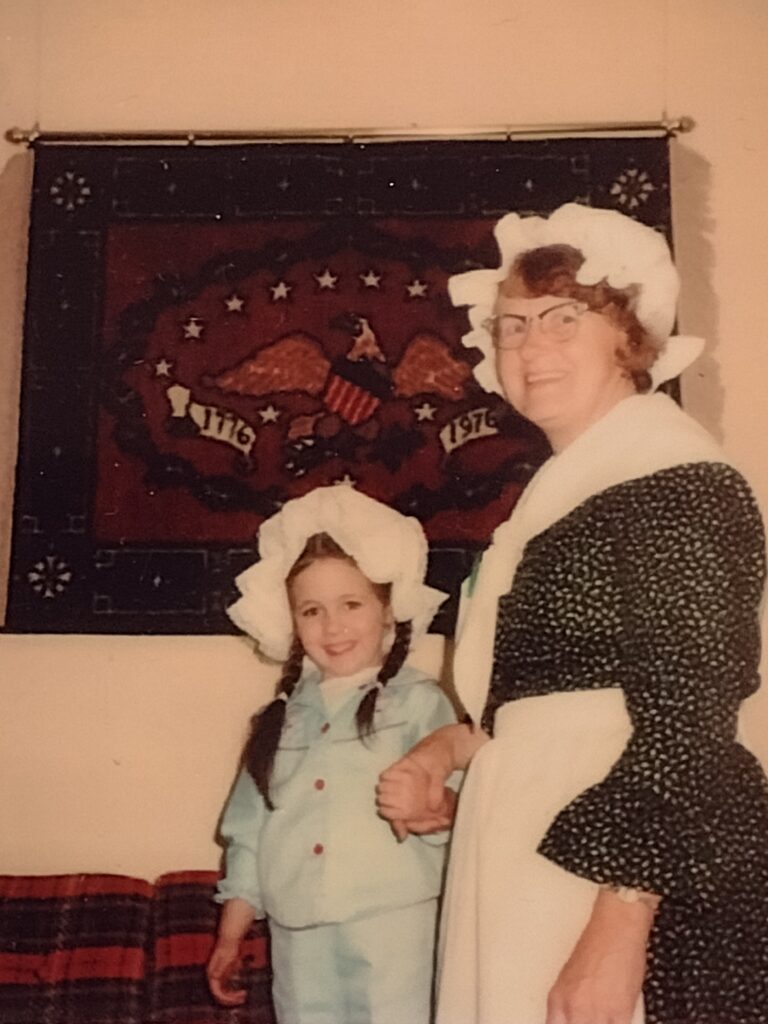
In the 1960s, Weis Library might have faded away quietly if Ester Bundy and more than 400 concerned citizens of northwest Pennsylvania hadn’t stepped forward to fight for it. Ester embodied what Robert K. Greenleaf later called servant leadership. “The servant-leader is servant first . . . it begins with the natural feeling that one wants to serve, to serve first. Then, conscious choice brings one to aspire to lead.”
This is the story of a woman who was only 5’2” in heels, but who stands tall in the history of a northwest Pennsylvania community. Often, when Ester Bundy met someone new, she’d shake their hand and say, “You just shook the hand of a real live Easter Bunny. My name is Ester Bundy. It is spelled E-S-T-E-R. I am too short to have a high old H in the middle of my name.”
Ester lived next door to Weis Library and had been very active in its community life. The library was founded in 1896 with funds from the estate of John Weis, a local farmer in Millcreek Township, outside of Erie, PA. According to his will, the library was free for all members of the community and for many years, it served as a vibrant center of learning and enrichment.
Unfortunately, in the 1960s, the trustees decided to permanently close the library, arguing that expenses had become too great to sustain operations. Ester’s long history with the library and the fact that she lived next door help explain why she couldn’t watch it close without speaking up.
Ester Bundy and more than 400 citizens mobilized. The name mentioned most often in newspaper accounts was Ester’s, that is, “Mrs. Don Bundy” as was the custom at the time. Ester appeared before the orphan’s court judge, organized community gatherings, and requested meetings with government officials, all to honor the last wishes of a humble farmer.
Testimony Did Not Save Weis Library
Despite their efforts, a 1965 court decision resulted in the permanent closing of Weis Library. The Honorable Judge James B. Dwyer wrote to Ester Bundy, enclosing a copy of his ruling. “I want to take this opportunity to thank you for all the time and effort that you put into this matter, and I regret that the testimony did not indicate that the Library should be kept open.”
Several years after the library closed, the Erie Sunday Times-News ran a letter to the editor written by Ester, in which she recalled her appearance before Judge Dwyer “to try to keep the funds of John Weis in library services as he had specified in his will.” She understood the importance of honoring donor wishes.
Ester continued in her letter that the Save Weis Library group had persuaded the Weis Library trustees to donate all the books and some Weis memorabilia to the Erie County Library, “where they could continue to serve the people specified in the will of John Weis to encompass all residents of West Millcreek, Fairview, and McKean Townships.” Then, because the trustees would not release any funds, the former patrons of Weis Library donated money to rebind the rare books and to purchase and refurbish the historic “Miss Columbia” piano.
“Miss Columbia is stoically awaiting a new home where she can again be played by concert masters for appreciative audiences,” Ester wrote. She added that the Save Weis Library group had also been patiently waiting for word of the proper disposition of the John Weis estate.
Clearly frustrated, Ester wrote, “I am again respectfully requesting that Weis funds be invested in library service to benefit all residents as John Weis had specified in his will by awarding the estate proceeds to the Erie County library NOW!!!”
After the library closed, the Weis trust awarded scholarships to area high school students as part of the will had stipulated. Eventually, whatever was left was donated to the National Merit Scholarship corporation. What happened to the library and to the trust is unfortunate, but at least Ester didn’t let the John Weis dream die without a fight.
Who was Ester Bundy?
Although Ester could not save the library, her untiring efforts became a major part of the legacy she left behind. She was an organizer, a leader, and a source of inspiration, seemingly untiring and endlessly focusing on what needed to be done without seeking recognition for herself.
Ester A. Brown was born on February 25, 1925, in Crawford County, PA, to Justin B. Brown and Emma Chambers Brown. Her father died just before her first birthday. She was the youngest child in her family, and her mother raised her in Springboro, PA. After Ester graduated from Erie Business College, she found a job at Bliley Electric Company.
On January 24, 1941, Ester and Don Bundy married. Don had graduated from Erie Commercial College and was employed by Erie Malleable Iron Company, where his father had also worked. By the 1960s, Don had become a financial executive at Erie Strayer Company. Ester and Don had four children, Karen, Richard, Thomas, and William.
An Adult Girl Scout, Teacher, and Encourager
Long before Weis Library closed, Ester began showing up in newspaper articles. For example, in 1949, she was reported as chairman of the annual Friendship Party of the Weis Library community.
Interestingly, Ester became an adult Girl Scout when she moved to Erie from Crawford County and looked for a way to get involved in the community. Daughter Karen Bryant said her mother served as den mother for her brothers. When Karen was old enough, her mother became her Girl Scout leader, and the troop met on the top floor of Weis Library. Ester went on to serve as a Girl Scout leader for around 25 years. She taught area troops about Girl Scout founder Juliet Gordon Low while wearing a 1912 Girl Scout uniform. A September 1997 Erie Times-News article reported that Ester had owned that uniform for nearly 50 years.
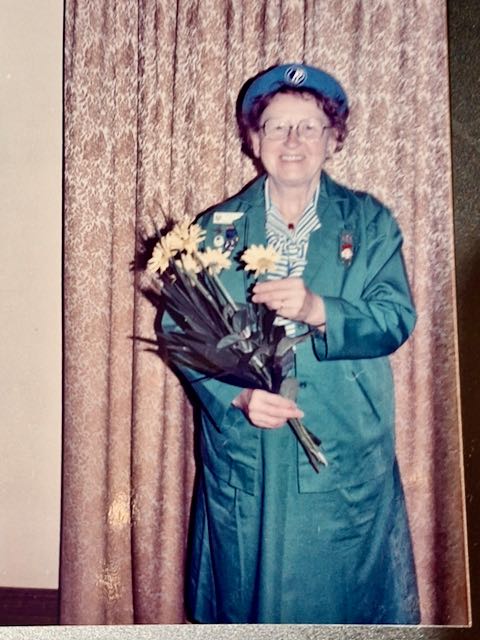
Ester in her Girl Scout uniform
The newspaper also reported that when Ester attended a Girl Scout jamboree celebrating the first 85 years of Girl Scouting, she gave lessons on knot tying. Commenting on the learning opportunities scouting provided, Ester said, “You learn by doing. Learning is so important. It makes life so much better.”
Karen Bryant said her mother also trained new leaders and started an adult group called the “Encourilators.” She sometimes accompanied Don on business trips, including some to Puerto Rico. “On one trip, my mom put on her scout uniform and took a taxi to the Girl Scout office in San Juan. She asked to meet whomever they were sending to a training event at the national camp in Rockwood, MD. That is how she met Helga L. Pérez Ríos, who then started an adult scout group in Puerto Rico. The groups would take turns visiting each other every five years,” said Karen.
Libraries, Lineage, and Civic Service
In addition to her involvement with the Girl Scouts, Ester was one of the founding members of Friends of the County Library, now Friends of the Erie County Library. She served as vice president, while Norman L. Hammer, who had been her co-chair of the Miss Columbia piano fund, served as president. In 1971 and 1972, she took on the role of president.
In 1979, Ester was admitted to the Presque Isle Chapter of the National Society Daughters of the American Revolution (DAR). She served as chapter librarian and traveled to Washington, DC, several times for national conventions of the DAR.
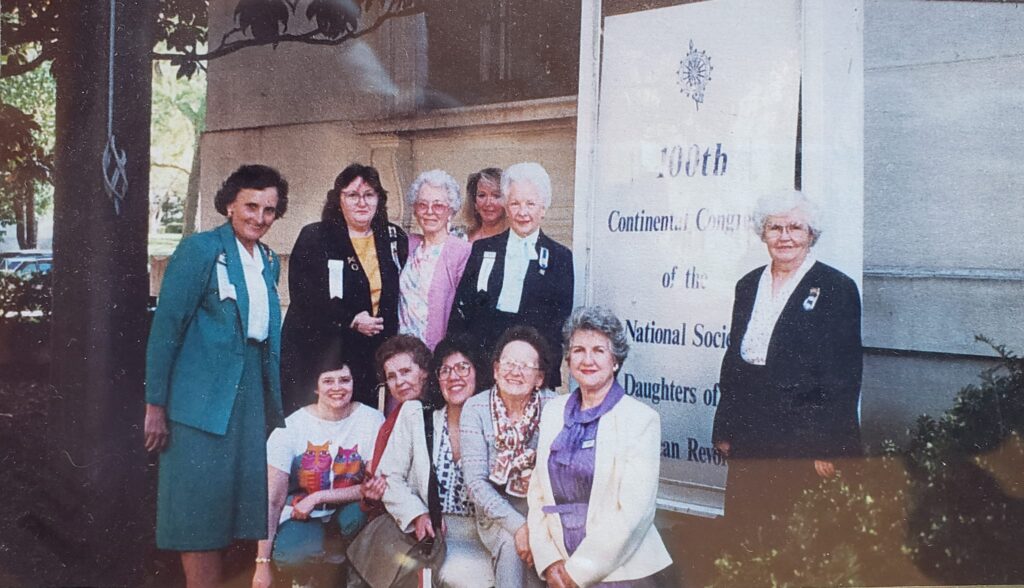
Standing, l,r: Marge Hazen, Patience Kroto, Ruth Williams, Marilyn Askey, Nora Fickle, and unknown. Kneeling, l,r: Joyce Thompson, Gladys Marnen, Kathy Hauser, Ester Bundy, and Betty Engel.
Kathy Hauser, past regent of the Presque Isle DAR, remembers Ester fondly. She said, “Ester Bundy was a unique and very supportive woman. Besides being an integral member of our chapter, she was also active in the ESGR [Erie Society for Genealogical Research], serving as editor of Keystone Kuzzins.”
Ester was a born teacher, according to Kathy. “I was on the phone with her one morning and mentioned that Alan [Kathy’s husband] and I had seen the most unusual insect sipping nectar from our bright pink garden phlox. It looked like both a large bee and a hummingbird. Ester correctly identified it as a hummingbird moth, just like that.”
Ester’s service also had a practical, everyday side as she managed a busy household. Karen Bryant recalls, “I had three older brothers, and we grew a lot of our own food. Every year, we canned peaches, pears, and grape juice. We made grape jelly and strawberry jam and stored them on shelves in the basement. We had a root cellar that held apples and potatoes. When our sweet corn was ripe, Dad picked it, filled the trailer behind the Gravely tractor, and parked it in the garage. My brothers and I had to husk the ears. Mom would blanch them and Dad would cut the corn off the cob.” Karen said they would take boxes of the corn to Parker’s Garage, at 26th and Peninsula Drive, where the boxes would be frozen and stored in a locker the Bundys rented. “We had corn for a year,” she said.
In 1991, Ester and her husband, Don, celebrated their 50th wedding anniversary at an open house hosted by their children at Weis Library United Methodist Church. They enjoyed another seven years of marriage until Don passed away in 1998.
Ester stayed involved in the community after losing her husband. In 1999, Ester was the recipient of a Jefferson Award for Outstanding Citizens for her service as a longtime Girl Scout leader.
In 2003, the Erie Times-News ran an article about proper ways to display the flag. It mentioned that Ester, representing the Presque Isle DAR, had been giving presentations for 40 years on flag etiquette and the proper ways to display it according to the United States Flag Code.
In another article, Ester referred to the flag as a living symbol of the United States. She said respect was an important reason for wearing the flag. “But the flag shouldn’t be worn in inappropriate ways. Some people think it’s funny to wear it on their rear end. But it’s better to wear it over your heart. That’s where I always put my flag pin.”
On May 30, 2004, Ester Brown Bundy passed away at age 84, leaving a rich legacy for her children and her community. The house she and Don raised their children in is now owned by the Millcreek School District and has a sign in front designating it “The Bundy House.”
Next door, the Weis Library building still stands. In the 1980s, when it was nearly ready for the wrecking ball, an enterprising couple purchased it and restored it as a personal residence. The building remains, but John Weis’s dream of a library there is no more.
Today, the Weis Library name remains on the face of the massive brick building, frequently prompting the question from passersby, “What was Weis Library?” Ester Bundy could have told them why it mattered, why John Weis’s dream deserved to be remembered, and why service sometimes means fighting for a legacy even when the fight is lost. Ester was a servant leader who left an expansive legacy in her community and among the people who knew her. Now you know her, too.
For more on Weis Library, read When a Legacy Fades: Weis Library and the Cost of Forgetting Donor Intent)
For more on Miss Columbia, read Can We Find Miss Columbia, Erie County’s Missing World’s Fair Piano?
