


When one bequeaths money for a specific good, it’s often to leave a legacy—something to keep alive the values they held dear. Over time, though, immediate memories of the donor’s vision fade. Times, values, and cultures change. The donor’s original vision may not hold as much importance to future generations, but it is still important to honor their philanthropic intentions.
Why? Of course, it’s a matter of integrity and honesty. But that’s not all. According to the Philanthropy Roundtable, “Deviations from and deliberate violations of donor intent will inevitably dampen the generosity of other donors, who might be reluctant to give out of fear that their wealth will be used for causes not of their choosing.”
Decades apart, one group in northwestern Pennsylvania fought an encroachment on Blasco Memorial Library, and another tried to save Weis Library. Both groups aimed to honor the intent of their benefactors.
The Raymond M. Blasco Memorial Library was erected in 1996, thanks to a $2 million endowment from Dr. Blasco. The funds were to be used for a public library, so that all Erie, Pennsylvania, residents would have free, public access to books, learning, and educational materials. The valuable bayfront property it sits on was donated by the local port authority and electric company to be used strictly for a library.
All was well at Blasco until 2023, when some Erie County officials agreed to rent 3,200 square feet of library space to a private university at drastically under-market terms. This precedent made the library vulnerable to further space grabs and stole space from the library’s visitors, many of whom come from marginalized segments of the community. Fortunately, the Keep Our Library Public group protested and ultimately sued the county and the university. After 18 months, the parties reached a settlement, and the lease was revised to protect the public’s interest now and into the future.
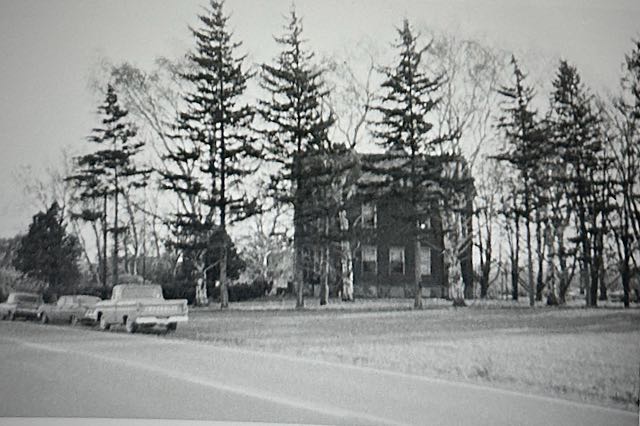
Nine miles south of downtown Erie, a three-story brick structure was built in 1896, with funds from the John Weis estate, which stipulated that the trustees should establish a public library to serve the community without distinction of race, color, creed, or sects. Weis Library fulfilled its mission through major wars, the 1918 Pandemic, and the Great Depression. Then, in 1964, the library’s trustees petitioned the court for permission to close the library, stating that the interest from the estate could no longer cover its maintenance and operations. A group called the Save Weis Library tried to save the institution, but in 1965, a judge ruled for the trustees. The library and its contents went to auction. The structure still stands but is now a private residence.
The Blasco Library issue is recent history, well-covered in social and traditional media, so from here on, we’ll go into some more detail on the Weis Library vision and closure.
ORIGINS OF WEIS LIBRARY
John Weis was a successful farmer whose parents were among the first settlers in Erie County. Born in Millcreek Township in 1819, Weis was a frugal man who never married. When he died in 1892, the community was surprised to learn that his $60,000 estate provided for the establishment of a public library to serve the residents of Fairview, McKean, and West Millcreek, a roughly 10-mile radius, “without distinction of race, color, creed, or sects.” The will also established merit and need scholarships for students from the townships the library served.
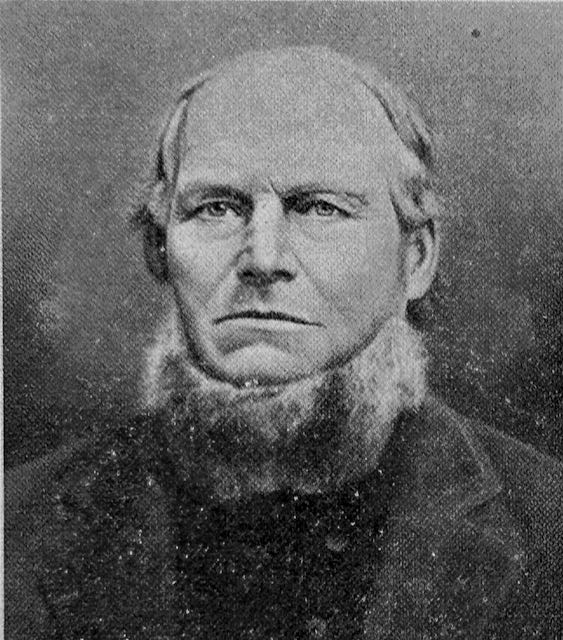
After two acres of land had been donated by Amos Hinkle (John’s brother-in-law), a dedication and grand opening was held on June 3, 1896, in the grand structure at the corner of Valley (now Sterrettania) and Thomas roads.
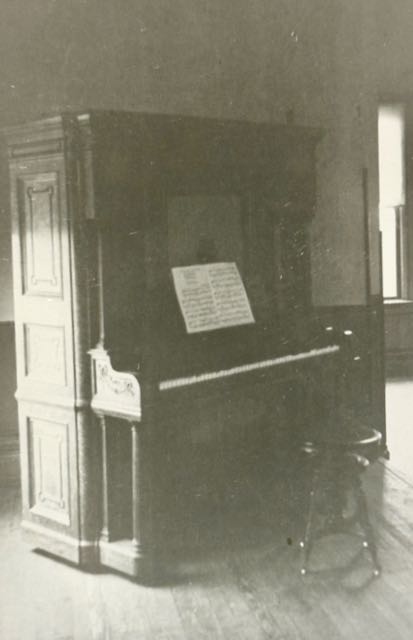
That same year, the Shaw Piano Company, which operated its factory in the City of Erie, donated a piano, called “Miss Columbia,” to Weis Library. The doubly veneered, Birdseye maple piano had been designed by students at a Philadelphia art school and displayed in the Pennsylvania Building of the World’s Columbian Exposition (World’s Fair) in 1893. “She” had also been exhibited in St. Louis, St. Paul, Williamsport, Philadelphia, Reading, Scranton, Rochester, Cleveland, Buffalo, and Erie before finding her home at the library. At her new home in Weis Library, piano lessons were given, and the instrument was also available for practice.
A VIBRANT COMMUNITY CENTER AND REPOSITORY OF KNOWLEDGE
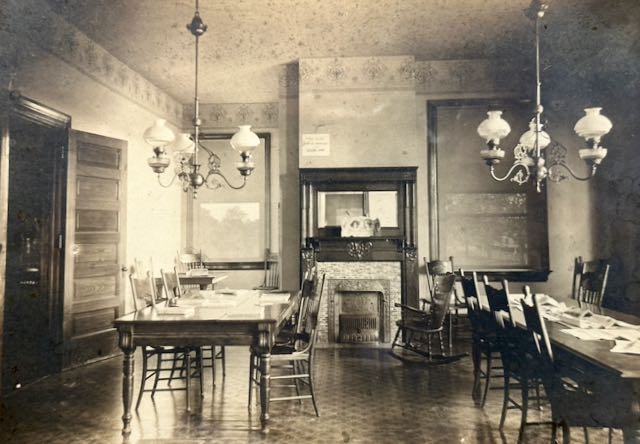
For the next 50 years, Weis Library (which also became the name of the surrounding area), served as a community center as well as a library. In addition to the library and post office on the first floor, the facility featured a basement dining room and kitchen and an upper floor hall for community gatherings. The library had become a venue for sewing bees, church socials, conventions, meetings, political-figure talks, debating and literary society gatherings, parties, ice cream socials, farmer meetings, family reunions, and recitals. There were a few restrictions, namely, no alcohol or dancing.
A 1903 article in the Erie Weekly Herald called it a farmers’ library, the only one of its kind in the United States. The library’s many features were listed, including many “hand-paintings” (including one of John Weis) and quaint “old-fashioned clocks,” including an eight-foot high one that had resided in the John Weis home. The article gave a short biography of John Weis and stated that his habits of thrift, economy, and perseverance earned him the name of “Reliable John.” It concluded with, “Thus, a monument similar to those of Andrew Carnegie has been left to the farmers, but without leaving a burden upon their shoulders. It is a legacy left to his fellow men and to the world by a plain, but far-seeing Presbyterian farmer—a monument more enduring than granite.”
By 1921, an Erie Times-News article announced the library was soliciting book donations. The article stated that Weis Library’s purpose was unique, not unlike the Carnegie Library, in that it laid no burden on the community it served. Its library, entertainment hall, and gathering space was offered to the community without charge.
In his April 10, 1949, local-history column, Erie Times-News reporter, Walter Jack wrote that Weis Library was America’s first rural community center and that it had been “an inspiration to better living, and a more satisfying neighborhood relationship.” Jack added that the library possessed several old books from the John Weis collection, including a 200-year-old German family Bible printed by monks from the cloister at Ephrata, Lancaster County, where the Weis family had first settled.
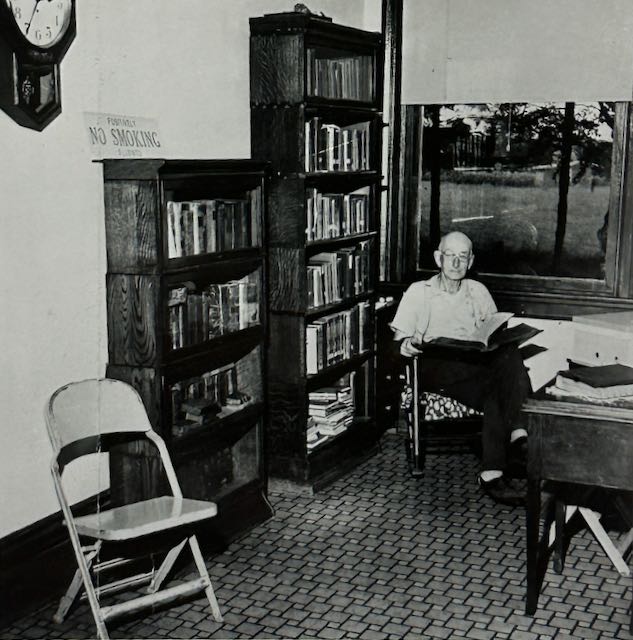
(Courtesy: Erie County Historical Society)
WHAT WENT WRONG?
It’s difficult to say exactly when Weis Library started its decline, but perhaps community engagement lessened during the Great Depression. An October 28, 1932, Erie Times-News article reported, “For years and years, folks from the neighboring countryside held meetings there free of cost, dined and made speeches in the dining hall, and then carried home an armful of books from the library.” The board of trustees had been forced into the unfortunate decision to cease free use of the facilities for meetings and events until the Depression eased. By the late 1940s, fees were no longer charged for use of the facilities for people of “the district,” but had the damage already been done?
Another factor might have been fading memories of the donor who had made the library possible. Every year, from 1897 to the mid 1930s, a founder’s day celebration served as a reminder and paid respect to John Weis. These celebrations, in conjunction with Flag Day, included services, orchestra performances, vocal selections, and recitations. These events culminated with pilgrimages to Erie Cemetery, where flowers were placed on the grave of John Weis.
For the next 30 years, the decline may have been so gradual that people hardly took notice, but by April of 1964, Millcreek supervisors started discussing the matter of a new library, because Weis Library had become “obsolete” and could “no longer provide good library service to Millcreek residents.”
Two months later, the John Weis estate trustees closed the library and petitioned the Erie County Orphan’s Court for the discontinuation of Weis Library, because the costs of building maintenance, personnel, and other expenses had exceeded the interest income on the estate. They said that for the past 15 years, it had been necessary to dip into the estate’s principal to cover expenses. The trustees asked the court to terminate the trust and for the remaining funds (around $40,000) to be used for scholarships to benefit the graduating seniors in the area. They remarked that the will’s stipulated a $100 scholarship had not always been adhered to because of lack of funds.
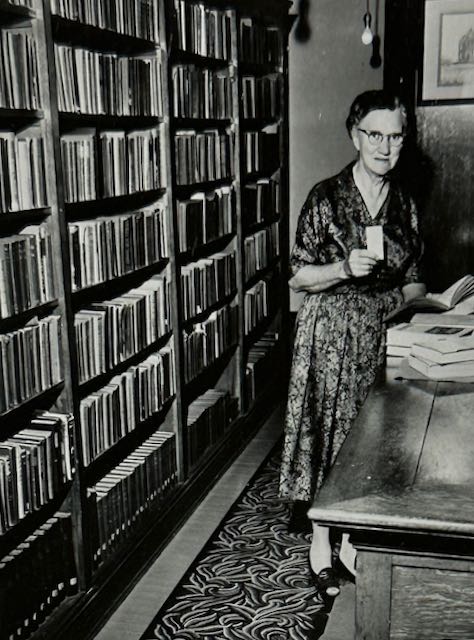
(Courtesy Erie County Historical Society)
COMMUNITY MEMBERS TRY TO RESCUE THE LIBRARY
On June 30, 1964, Judge James B. Dwyer gave residents until September 1st to come up with a feasible plan to save Weis Library. This gave the residents only two months to organize and come up with a plan. Who would take this on?
Enter Ester Brown Bundy (1920-2004), usually referred to in newspaper articles as “Mrs. Don Bundy,” as was the custom at the time. Bundy was the secretary and spokesperson for the “Save Weis Library” committee that represented around 400 petitioners who wished to keep the library open. On November 24, 1964, Bundy, a Millcreek resident, along with four other individuals, Mrs. Edwin Vogel and Karl Newberger (McKean), John Ramsey Brown (Millcreek), and Donald Waidley (Fairview), asked Millcreek Township supervisors to keep Weis Library open, and for it to be used by the Erie County Library, rather than opening a new facility in the Millcreek municipal building.
The County Library Board seemed to concur with the group trying to save Weis Library. They told county commissioners that they did not have the financial resources to repair and maintain the facility. They recommended that the commissioners repair, maintain, and operate it, because of its location in a growing area of the county and an “ideal spot for maintaining library service.”
Unfortunately, the day after the petitioners made their appeal, county administrators indicated they were not inclined to assume the costs of maintaining Weis Library. They said that they were already contributing $30,000 per year to the County Library Board and if the Board wanted to maintain Weis Library, they’d have to take it out of their own budget. They were willing, however, to make small grants to area communities to establish their own libraries, while maintaining the libraries themselves.
Ester Bundy responded by organizing a meeting with the three county commissioners and the supervisors of the three townships before the next court hearing on November 30. By December 11, Orphans Court Judge James Dwyer had scheduled the final hearing for January 5, 1965, and the county commissioners were asking for clarifications on the Weis will and on what their responsibilities would be if they assumed Weis Library.
Save Weis Library maintained that the estate’s assets were more than sufficient to repair the structure. Ester Bundy further argued that in 1960, the Erie County Library had approached the estate’s trustees for permission to take over and maintain Weis Library, but that no action was ever taken on the bid.
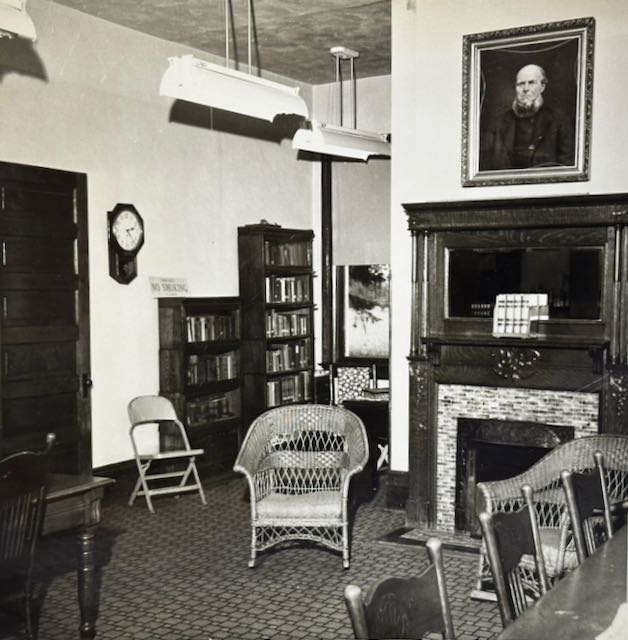
Bundy said, “Certainly the building would be far more suitable than a room next to Millcreek’s jail for use as a library. It is quiet, accessible, and much larger. We want to see Weis Library renovated and its book collection updated to offer adequate service to the entire county.”
Millcreek supervisors agreed that the library should be kept open and renovated because of its historical significance. Supervisor Paul J. Martin said at a meeting of Millcreek, Fairview, and McKean supervisors and the Save Weis Library committee that the county commissioners should decide how costs should be shared across the four bodies. Supervisor Ross Wilkins said too many historical landmarks, such as the Wolverine in Misery Bay, the Old Half-Way House, and the old Head Inn had been lost to disinterest. At the same time, he said the offer to host the library in the municipal building still stood. . . The supervisors obviously wanted a library for its community, whether it be at Weis or the municipal building.
At the request of the estate trustees, the County Library Board, and the representatives of the 400 petitioners who wanted to save Weis Library, Judge Dwyer delayed the final hearing. The County Library Board had proposed that the county assume the cost of operation with the library board administering it. Ultimately, county commissioners unanimously voted not to fund Weis Library.
On June 4, 1965, Judge James B. Dwyer issued a judgment approving the Weis liquidation, and the residue used to establish a scholarship fund. He ordered the proceeds to be invested in legal securities to aid needy and meritorious students from Fairview, McKean, and Millcreek.
The same day, he sent a letter to Ester Bundy enclosing a copy of the ruling. He wrote, “I want to take this opportunity to thank you for all the time and effort that you put into this matter, and I regret that the testimony did not indicate that the Library should be kept open. No doubt you are disappointed in this conclusion, but I am sure you realize that from the testimony presented there realy [sic] is no other option than to close the library and to allow what funds remain to be used for scholarship aid to needy students of your area.”
Resigned to the disappointing decision, in August of 1965, the Save Weis Library Committee met with Pennsylvania State Librarian Ernest Doerschuk, Jr. and he told them how much aid the state could provide. The committee hoped to build a new library with the help of either the PA Library Board of the Pennsylvania Historical Commission or County Library Board. They suggested that the Weis estate funds be turned over to the county to be used as matching funds for a federal grant on new construction. The committee promised the new library would be strategically located to serve all county residents. This was never done.
BUILDING AND CONTENTS AUCTIONED
On October 16, 1965, the library’s 69-year-old building and land were auctioned off for $7,400 after only ten minutes of bidding. Thomas T. Sterrett, one of the estate’s trustees, acted as the auctioneer. He asked for an opening bid of $10,000 but received a bid of only $1,000. After that, the bidding quickly progressed but then waned at $6,500, inching further to the final bid. The new owner said he had no immediate plans for the property, which had, not long before, been valued at $57,000.
Two weeks later, the contents of the building went up for auction. The approximately 5,000 books were to be donated to the Erie County Library and a small number of them, from the personal library of John Weis, were to be given to the Erie Public Museum. Advertisements for the contents auction listed complete furnishings, including a piano, tables, chairs, two clocks, a davenport, gas stoves, dishes, and other items. Proceeds of the auction brought $500 to the estate from “several scattered buyers during the well-attended sale.”
(Courtesy: Erie County Historical Society)
MISS COLUMBIA SAVED BY PIANO FUND COMMITTEE
Of the $500 in proceeds from the contents auction, $255 came from the purchase of the “Miss Columbia” piano that had been donated to Weis Library in 1896. Ester Bundy and Ralph L. Hammer had organized the Miss Columbia Piano Fund, a segment of the nearly $750 that had been raised from approximately 125 donors. In addition to the piano’s sale price, additional funds went toward tuning the piano and replacing its ivories, framing its credentials, and moving it to the new Millcreek branch of the Erie County Library system, now located in the Millcreek Municipal Building. The remainder of the fund was to be used for further refurbishing, rebinding books, and restoring Weis memorabilia for display in suitable housing, at discretion of Erie County Library.
Miss Columbia received a warm welcome to its new home, thanks to those who had tried to save the library. At an open house held at the Millcreek Branch, Harold Oliver, grandnephew of John Weis, introduced her to “friends and relatives she [hadn’t] seen for over 50 years.” Descendants of John Weis played the newly tuned instrument.
Where is the piano today? It’s currently a mystery. If you have information, please leave a comment below.
TWENTY YEARS OF DETERIORATION FOR THE FORMER LIBRARY
In the 20 years after the auction, the Weis Library property changed hands at least one more time with a local doctor allegedly using it as a warehouse to store antiques. In the Sunday Times-News on March 9, 1986, Lisa Lassman [now Kerner] reported, “Twenty years of neglect are evidenced by the unkempt landscape and the ramshackle sheds that surround the structure. Vandals, perhaps spurred by a spooky local legend, have visited and left their mark. Bricks, stolen one by one have caused portions of the walls to crumble.”
Lassman’s article reported that when the property was offered for sale two months prior, not one bid satisfied the $50,000 minimum threshold. A Millcreek supervisor said that zoning laws required that the building be occupied or torn down. The co-executor of the late doctor’s estate said, “We’ll dispose of it one way or another.”
Who knows what would have happened to the Weis Library building, if Elena and Dennis Horwath hadn’t read Lassman’s article? They purchased the property and began a mighty renovation project. When they took possession, they found empty liquor bottles, food, old newspapers, and photos of the original library. The building was transformed from dilapidated library to an elegant residence included on non-profit holiday tours. It is still maintained well today.
WHAT HAPPEDNED TO THE JOHN WEIS SCHOLARSHIP AND THE ESTATE?
When the trustees petitioned to closed the library in 1964, they stated that they had not always been able to honor the scholarship directive from the John Weis will. There is evidence that it was awarded, though, such as in 1953 when the scholarship was awarded to the valedictorian of McKean High School, Fredora Otteni. The last John Weis scholarship was awarded in 2001 to Maria Yount.
Each year from 1974 to 1994, a notice for the annual report of the Weis Library Trust was published in the classified section of the Erie Times-News, stating that the report could be viewed at a local law firm. In 1996, the trust was finally terminated. The funds were to be disbursed under the terms of the trust to the National Merit Scholarship Corp.
A query to the National Merit Scholarship Corporation confirmed that between 1976 and 2001, the John Weis Trust provided a total of 14 scholarships. A response to a query stated, “No arrangements were made for scholarships to be offered after the 2001 competition.” Further research would be needed to determine how these scholarships were funded and the exact funds that were ultimately remitted to the corporation.
A LESSON IN STEWARDSHIP
Like many of us, John Weis left money that he thought would benefit his community in perpetuity. His estate is an example of how this does not always happen. Was the fund inadequate? Did Weis not select the right trustees? Did the succession of trustees not serve to protect his estate?
One of the letters sent to the Horwath family stated that the rents received from the real estate holdings in Erie were to fund the library. Those properties were sold off in the 1930s, during the Great Depression. Judge Dwyer’s ruling to liquidate the library was made under the assumption that the property was worth around $50,000, and yet the sale only yielded $7,900. Even though the library had closed, the trust fund for scholarships probably could have lasted in perpetuity if they had been able to realize more from the sale of the property.
The structure still stands, and lovers of architecture seem to be happy about that, but now that it has been turned into a private residence, only the current owners and their guests can enjoy it.
How would John Weis feel about what happened to his desire to provide library services to all in proximity to his farm and the three townships that surrounded it? The library and the scholarships no longer exist. Everything that John Weis left his money for is gone.
What if Weis Library had never closed? The students from Asbury and Walnut Creek could visit. It certainly would be closer for many nearby residents than the library branches at Millcreek Mall and Fairview. Yes, the building is old. Yes, Wi-Fi or cellular signals might be an issue, but mesh access points for Wi-Fi and distributed antenna systems for cellular would have solved that. Every time I drive by Weis Library, I’m grateful to the family that saved the structure, but I mourn the loss of John Weis’ legacy and my own inability to while away hours in the reading rooms of a long-standing library.

Anna McCartney
Thanks for shedding light on when donor intent and legacy conditions are violated. Sadly the public who was meant to benefit from the donation is left out.